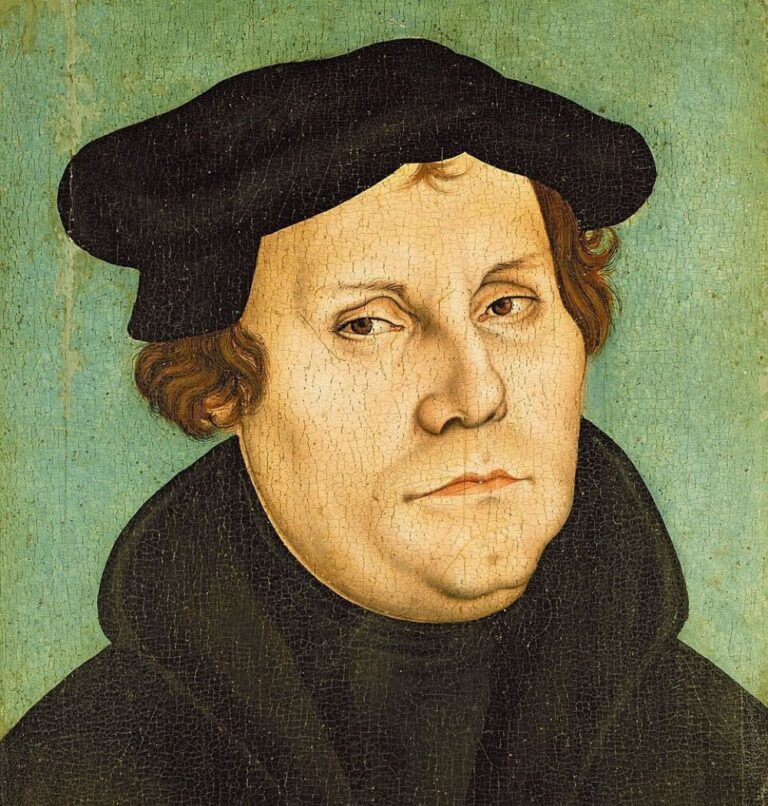
Who is Martin Luther? If you’re part of the Lutheran, Reformed or Protestant churches, you may already know a little bit about him, but his story is fascinating, even from a secular perspective.
Let’s dig in to find out why he challenged the Catholic Church, what led to his excommunication and how he inspired the religious revolution known as the Great Reformation.
Table of Contents
Early Beginnings and Lightning Strike Turn to Faith
Martin Luther was a humble, fiery monk and priest in 16th century Germany. His story is fairly ordinary until he became the catalyst for the Protestant Reformation.
His life took an interesting turn in 1505. While he was studying law at the University of Erfurt, he was riding on horseback when a lightning bolt struck nearby and knocked him to the ground.
Fearing for his life, he cried out to Saint Anne, the patron saint of miners, promising to lead a religious life and become a monk if he survived, which is exactly what happened.
Everything was proceeding according to plan, and he was officially ordained in 1507. But then, roughly 10 years later, something inside him snapped.
Tetzel’s Controversial Indulgences
“As the coin in the coffer rings, the soul from purgatory springs.” – A jingle by Johann Tetzel
In the part of Germany that’s known as Lutherland today, a friar named Johann Tetzel was busy selling indulgences, a system for collecting money in exchange for forgiving someone’s sins or even releasing a deceased relative from purgatory in exchange for money.
These funds were being sent back to Rome where they were being used to rebuild St. Peter’s Basilica. This system of paying for repentance and following the laws of the papacy in Rome over the word of God certainly rubbed Luther the wrong way and went against everything he believed in.
The 95 Theses and All Hallows’ Eve
Martin Luther had two key beliefs: salvation comes through faith alone, and the Bible is the supreme religious authority. He used these basic two beliefs to build 95 separate arguments or theses that he nailed to the door of the All Saints’ Church (also known as the Schlosskirche or Castle Church) in his hometown of Wittenberg, Germany.
No one knows for sure, since record-keeping from over 500 years ago was obviously not as accurate as it is today, but sources seem to confirm that Luther sent his theses to the Archbishop of Mainz and most likely nailed them to the door of the church the very same day on October 31st.
Is it a coincidence that he publicized his grievances on All Hallows’ Eve, the night before All Saints’ Day? I don’t think so. Irony was not lost on Martin Luther. While many people today recognize this day as Halloween, for Protestants, it’s known as Reformation Day.
Luther, a pithy writer even by today’s standards, used strong, pointed language to challenge the ideology of the Catholic Church. For example, Theses 86 asks:
“Why does the pope, whose wealth today is greater than the wealth of the richest Crassus [a general who was the wealthiest man in Rome], build the basilica of St. Peter with the money of poor believers rather than with his own money?”
Honestly, that’s a pretty good question.
Luther Goes Viral Thanks to the Printing Press
The 15th and 16th centuries were critical times for religious ideology. Johannes Gutenberg invented the first mechanical printing press with reusable metal type in 1440, and he completed the famous Gutenberg Bible in 1455.
This new technology allowed Luther’s words to quickly be translated from Latin to German and distributed across the country. Many modern sources claim that the materials were republished and distributed across Germany in a matter of weeks and across Europe in a matter of months. It was the equivalent of going viral today.
However, instead of welcoming debate, the Catholic Church and its leaders doubled down. Tetzel, in particular, responded by publishing his own theses, stating that Christians must be loyal to the Church (not Scripture) and obey the authority of the Pope and his leaders.
Controversy at the Diet of Worms
Like any viral video, the controversy didn’t die down right away. Instead, Luther was kicked out of his order, and the ramifications of his actions continued for several years.
At first, the Church believed that the 95 Theses were simply inviting academic debate, but after a while, they took them more seriously. This led to hearings (Diets) in Augsburg and eventually Worms.
It would seem that the legal system in Germany and the administrative system in the Church were equally slow. It’s also possible that things escalated when Luther publicly burned the Pope’s warning letter in December 1520.
On January 3, 1521, more than three years after nailing the Theses to the door, Luther was summoned to the Diet of Worms. Even Emperor Charles V of the Habsburg dynasty was present. They demanded that Luther recant his message. But he did not. He remained more determined than ever.
“Unless convinced by Scripture or evident reason, I will not, I cannot recant. My conscience is captive to the Word of God. To go against conscience is neither right nor safe. Here I stand, I can do no other, God help me. Amen.”
Excommunication, Kidnapping and Life in Disguise
Martin Luther was officially excommunicated from the Church by Pope Leo X the very same day. If you thought this was dramatic, hang tight because the story gets even crazier!
Luther was declared a heretic, meaning that he was officially outside the protection of the law. As a fugitive, anyone was welcome to capture or kill him. Fortunately, Luther had a powerful and wealthy benefactor, Frederick the Wise of Saxony. The prince arranged for a staged kidnapping, and Luther disappeared from public view.
At the same time, a new face appeared in the northern bastions of the Wartburg Castle, a UNESCO World Heritage Site, where captured knights or nobles would have been detained. Luther allegedly grew a beard styled in the royal fashion and began calling himself Junker Jörg, meaning Knight (or Young Lord) George. You can find a portrait of Martin Luther as Junker Jörg online through the Royal Collection Trust.
Translating the New Testament
Luther stayed in hiding within the castle for over 10 months. Even Prince Frederick’s brother was unaware of the heretic’s presence. While he was in hiding, Luther undertook one of his great achievements.
He completed a landmark translation of the New Testament, translating the original Greek into vernacular German, creating one of the most readable versions of the Bible for followers at the time.
He completed the work in just 11 weeks, translating roughly 1,500 words per day. When the text was published in 1522, it sold some 5,000 copies in about two months, showing the immense power of the printing press and Luther’s inimitable voice.
Martin Luther: The Musician
Not only was Luther an accomplished writer and theologian. He was also an excellent musician and singer who would often lead performances after dinner. He once wrote, “I have no use for cranks who despise music, because it is the gift of God. Next after theology, I give to music the highest place and the greatest honor.”
He wrote numerous hymns, and more than 20 of his hymns are used in modern Lutheran churches today. One of his most famous, A Mighty Fortress Is Our God, still endures and is instantly recognizable roughly 500 years later.
Martin Luther & Katie von Bora
Luther also had an interesting relationship with his wife Katharina von Bora, an ex-nun who is sometimes called the Mother of the Reformation. She and 11 other nuns escaped from their convent in herring barrels after reading his teachings. There are numerous books about her as well. But for now, we’ll stick to Martin Luther.
Resources
If you want to learn more about Martin Luther and the history of the Protestant Reformation, there are numerous excellent resources.
Start with Rick Steves’ one-hour documentary: Luther and the Reformation. Steves is a Lutheran, so he really knows his stuff and is passionate about the subject.
Further Reading
Rebel in the Ranks: Martin Luther, the Reformation, and the Conflicts That Continue to Shape Our World by Brad S. Gregory
Martin Luther: Renegade and Prophet by Lyndal Roper
Luther's Small Catechism with Explanation - 2017 Spiral Bound Edition by Martin Luther
Brand Luther: How an Unheralded Monk Turned His Small Town into a Center of Publishing, Made Himself the Most Famous Man in Europe by Andrew Pettegree
The Bondage of the Will by Martin Luther - J. I. Packer - O. R. Johnston
Here I Stand: A Life of Martin Luther by Roland H. Bainton
Katie Luther, First Lady of the Reformation: The Unconventional Life of Katharina Von Bora by Ruth A. Tucker
Luther and Katharina: A Novel of Love and Rebellion by Jody Hedlund